
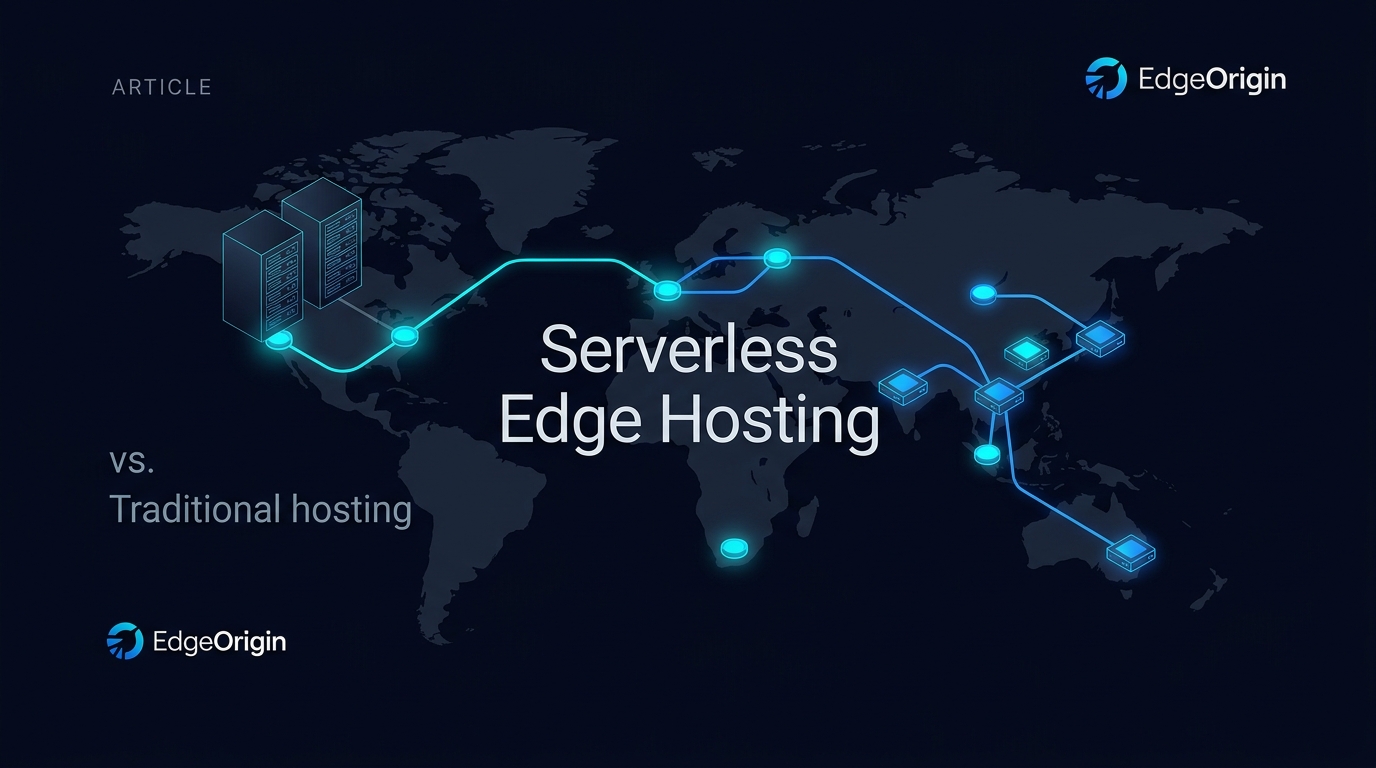
Understand how managed serverless edge hosting works, how it compares to shared, VPS, and dedicated servers, and when edge-native architecture makes practical sense.
What Is Serverless Web Hosting?
The phrase “serverless web hosting” can sound contradictory. Websites always require physical computing machinery to process requests, execute logic, and transmit HTML to web browsers.
In practice, serverless does not mean that servers no longer exist. It means that you, as the website owner, never buy, configure, maintain, patch, or manage a specific server. Instead of renting an ongoing virtual machine or physical hardware that sits idle waiting for traffic, your web pages and application logic run on-demand across a distributed global edge network.
When a visitor types your domain into their browser, the closest edge node in the global network spins up a secure execution environment, compiles or retrieves the page via server-side rendering (SSR), queries the edge database, and returns clean HTML in tens of milliseconds. Once the request finishes, the compute resources instantly release.
How Traditional Web Hosting Works
To understand why serverless edge hosting has gained significant traction, it helps to understand the three dominant models that powered the web for the past twenty-five years:
1. Shared Web Hosting (The Apartment Building)
In shared hosting, hundreds or thousands of separate customer websites share the operating system, memory, CPU, and web server of a single physical machine.
- Strengths: Highly affordable ($3 to $10/month), easy one-click installations for traditional CMS scripts, and cPanel-based control.
- Vulnerabilities: Susceptible to the “noisy neighbor” effect—if another site on the same physical server suffers a traffic surge or security issue, your site slows down or crashes. Furthermore, content is served from one fixed geographic data center.
2. VPS Hosting (The Townhouse / Condominium)
A Virtual Private Server partitions a physical machine into virtual private instances. You receive dedicated CPU cores, RAM, and root operating system access.
- Strengths: Predictable hardware allocation, dedicated file systems, and freedom to configure custom runtimes, background services, or memory caches.
- Vulnerabilities: Substantial administrative overhead. You are responsible for Linux kernel updates, security patching, firewall rules, web server SSL renewals, and scaling up the instance when memory runs low.
3. Dedicated Servers (The Standalone Private Property)
A dedicated server gives you exclusive access to an entire physical rack server in a data center.
- Strengths: Maximum raw processing throughput, zero resource contention, and total architectural freedom.
- Vulnerabilities: High baseline operational expense ($100 to $500+/month), manual hardware failover risks, and single-origin latency for visitors located across different continents.
What EdgeOrigin Actually Provides
EdgeOrigin takes a modern architectural approach: managed serverless edge hosting tightly integrated with an AI-native visual CMS.
Rather than hosting your site on a single server in North America or Europe, EdgeOrigin distributes your website across a global network of over 300 edge locations worldwide.
- Global Server-Side Rendering (SSR): Every page request executes at the edge node geographically nearest to your visitor. This delivers average Time to First Byte (TTFB) well under 50ms without requiring heavy client-side JavaScript bundles to hydrate in the visitor’s browser.
- Authoritative Distributed Database: Site configuration, page hierarchies, editorial guides, and navigation trees are stored in an edge database with strict tenant-level cryptographic isolation.
- Automated TLS & Domain Routing: When you connect an apex domain or subdomain, automated SSL/TLS certificates renew without manual intervention, supporting modern HTTP/2 and HTTP/3 protocols.
- Optional Cloud Media Storage Plugin: For media-heavy publications, portfolios, and news portals, high-capacity cloud object storage can be activated as a modular plugin.
- Built-In Statutory SEO: Canonical tags, Schema.org JSON-LD structured data, and search engine XML sitemaps are generated automatically on publication.
Side-by-Side Comparison Matrix
Here is how managed serverless edge hosting compares directly to conventional hosting infrastructure:
| Hosting Factor | Shared Hosting | VPS Hosting | Dedicated Server | EdgeOrigin Managed Edge |
|---|---|---|---|---|
| Execution Location | Single origin data center | Single origin data center | Single origin rack | 300+ global edge locations |
| Server Administration | Managed by host provider | Self-managed (OS, security, web server) | Full self-management required | Zero DevOps (fully automated) |
| Traffic Spikes & Scaling | Throttled or offline | Manual CPU/RAM upgrades | Capped at physical hardware limits | Automatic concurrent edge scaling |
| SSL Certificates | Basic or paid add-on | Manual Certbot configuration | Manual installation & renewal | Automated provisioning & renewals |
| Security & Patching | Host-level; plugin risks | User handles Linux & package CVEs | User handles all hardware & OS patches | Managed runtime; zero OS exposure |
| AI Agent & MCP Access | Not supported natively | Requires custom tooling | Requires custom tooling | Native site-scoped MCP API (Pro) |
Maintenance & Operational Responsibilities
It is important to be realistic: serverless edge hosting does not eliminate all human responsibility. It shifts your focus away from low-level systems administration so you can concentrate on your business.
What EdgeOrigin Manages:
- Runtime Infrastructure: Edge execution nodes, distributed routing, compute autoscaling, and network reliability.
- Security & DDoS Protection: Global perimeter defenses, rate limiting, and zero-day patch mitigation.
- SSL/TLS Renewals: Automated cryptographic certificate issuance, renewals, and HTTP/3 handshakes.
- Cache Management: Instant cache invalidation across all edge points of presence whenever content is published or updated.
What You Still Manage:
- Domain DNS Records: Directing your CNAME or Apex records to your EdgeOrigin workspace through your registrar.
- Editorial Content & Media: Writing accurate copy, uploading properly licensed images, and verifying service facts.
- Access Governance: Protecting admin credentials and issuing site-scoped API tokens only to trusted AI coding agents.
Pricing & Cost Considerations
Traditional web hosting often starts with artificially low teaser rates that increase sharply upon annual renewal, accompanied by add-on charges for SSL certificates, backup plugins, security suites, and CDN traffic.
EdgeOrigin provides predictable, verified subscription tiers that bundle edge hosting, CMS software, SSL, and automated sitemaps into a single subscription:
-
Starter ($0 / month): 1 website on an
edgeorigin.appaddress, 1 GB storage, unlimited edge page views (Special Launch Offer), visual CMS editor, and free SSL. Ideal for testing, student projects, and proof-of-concepts. - Pro ($5 / month or PKR 1,499 / month): 1 website with custom apex/subdomain mapping, automated SSL, site-scoped Model Context Protocol (MCP) developer access, 10 GB storage, unlimited edge page views (Special Launch Offer), and priority edge routing. Built for local businesses, active publishers, and consultants.
- Agency ($29 / month): 5 separate client workspaces, white-label options, priority edge delivery, 50 GB storage, up to 1,000,000 monthly page views, and multi-tenant management. Designed for agencies and freelancers delivering client deliverables.
Practical Trade-Offs & Limitations
Honest engineering means acknowledging trade-offs. Serverless edge hosting is not suitable for every conceivable web use case:
- Custom Linux Daemons & Background Processes: If your project requires running custom C++ binaries, background FFmpeg video rendering queues, or specialized socket servers, a self-managed VPS or Kubernetes cluster remains the appropriate tool.
- Legacy Monolithic Plugins: If your workflow relies on legacy PHP plugins that mutate server file systems on disk, serverless edge hosting does not support arbitrary server-side code execution outside of sandboxed plugin hooks.
- Low-Traffic Cold Start Variance: While edge execution startup latencies measure in milliseconds—far quicker than traditional server cold starts—infrequently accessed endpoints can occasionally see slight execution variance on unprimed edge caches.
Frequently Asked Questions
Can high-traffic websites run on serverless edge hosting?
Yes. Serverless edge architecture is exceptionally well-suited for high-traffic sites and viral spikes because incoming requests are distributed across hundreds of global edge nodes simultaneously, avoiding single-server RAM or CPU bottlenecks.
Do I need to configure a separate CDN?
No. EdgeOrigin executes server-side rendering directly inside the global edge network. Dynamic HTML and static assets are delivered from the edge cache automatically without configuring third-party CDN proxies.
Can I use my existing domain name registrar?
Yes. You retain full ownership of your domain at any registrar and simply point your DNS CNAME record to your EdgeOrigin workspace.
Can non-developers edit articles and pages?
Yes. EdgeOrigin provides an intuitive visual CMS. Content creators, editors, and business owners can update copy, adjust layouts, and upload media without interacting with code or terminal tools.
EdgeOrigin publishes practical technical guidance grounded in verified platform architecture. We do not promise arbitrary search rankings or zero downtime. Review hosting options based on your organization’s genuine scaling, maintenance, and technical needs.
Ready to Experience Serverless Edge Hosting?
Launch your first website on EdgeOrigin in minutes with zero server configuration. Start completely free or explore our Pro plans.